What Nepal Fed Me: A Complete Guide to Nepali Food
Discover authentic Nepali food through a real travel story, from dal bhat and momos to Newari specialties and thukpa in Himalayan teahouses.
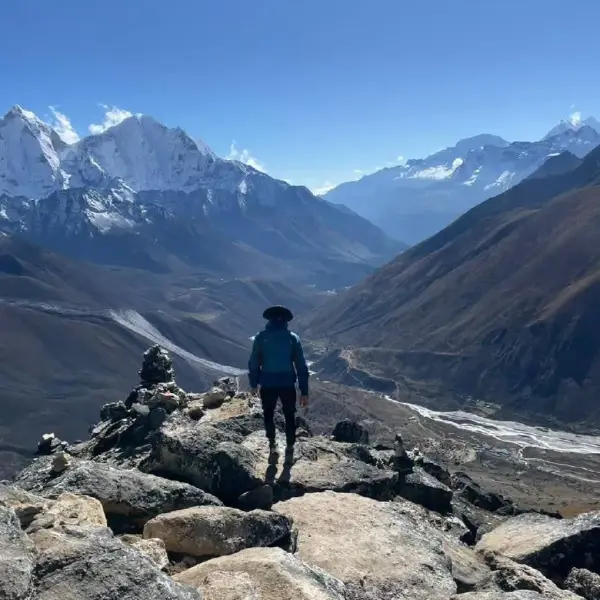

Morning in Kathmandu starts slow — a glass of milk tea, maybe with gwaramari or sel roti, before the real action begins. By mid-morning, momo steamers are rattling, samosas are frying, and Ason Bazaar is in full swing. That's the rhythm most visitors learn fast: Nepali food isn't rushed, it unfolds.
Somewhere behind me, a trekker muttered "dal bhat power, 24 hour" to his partner, half joke, half prayer. Two weeks later, after Kathmandu's chaos, Newari kitchens in Bhaktapur, and teahouses along the trekking routes, I understood exactly what he meant.
This is a guide to Nepali food, told the way it's actually eaten, as a journey, not a menu. The same plate of dal bhat tastes different in Kathmandu, and at 4,000 meters, and that difference is most of what this guide is really about.
1. Kathmandu: Where the Chaos Has a Flavor
Kathmandu doesn't ease you in. Between the crowds, the busy city, and vendors calling out prices, your first meal in the capital usually happens by accident, you follow a smell down an alley and end up eating whatever's being made in front of you.
Ason Bazaar is where I'd point to anyone chasing genuine street food in Kathmandu. It is one of the city's oldest trading squares, and comes alive before most tourists are awake. Spice sacks are hauled off handcarts, tea is poured in small cups without spilling a drop, and every stall is already mid-service by early morning. It's chaotic, and it's exactly where the city's food identity is loudest.
1. Momo
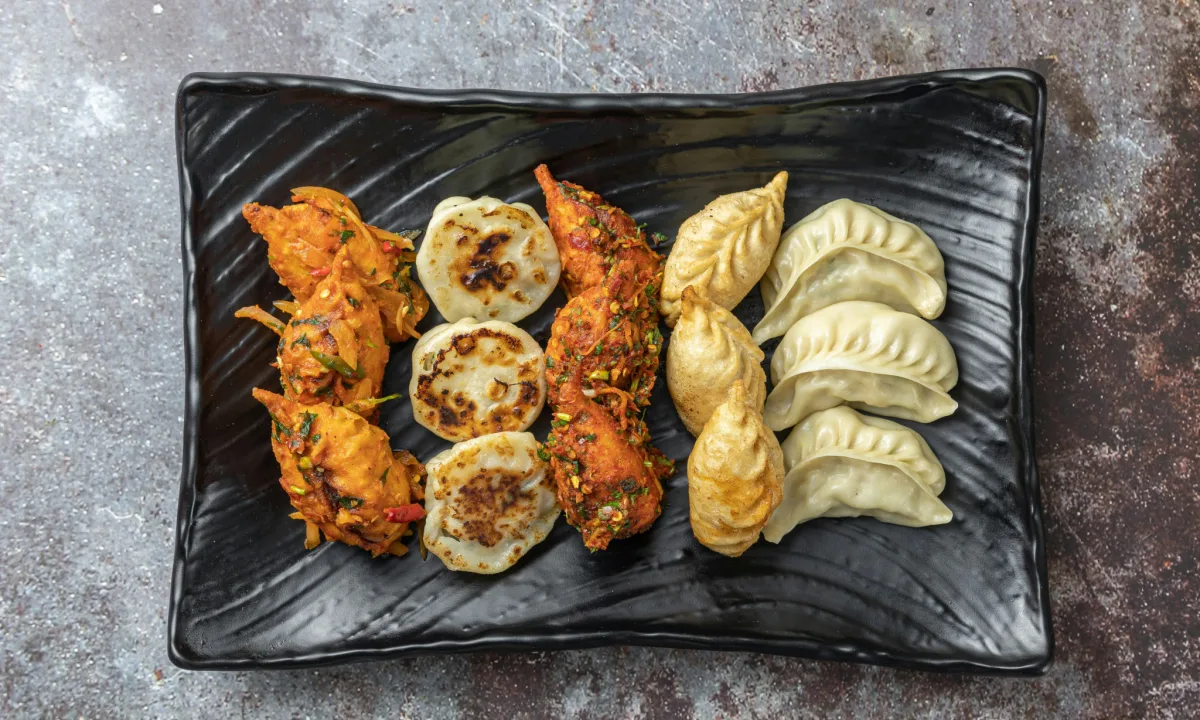
A momo is a Nepali dumpling, typically wheat-flour dough folded around a spiced filling of minced meat or vegetables, then steamed or fried, and served with a chili-based dipping sauce called achar. Momos are everywhere in Nepal, from tiny street stalls to neighborhood restaurants, and have become one of the country’s most beloved everyday foods.
Vendors in Kathmandu often sell out by early afternoon, so hunting for momos, Nepal's steamed dumplings, is best done before noon, not after. At around 4 p.m., while strolling through New Road, I spotted a small momo shop serving fresh, steaming batches. Ten dumplings, a bowl of sesame-tomato achar, and the Nepal trip finally felt like it had started.
2. The Samosa and Samosa Chaat Hunt
One of the first snacks I gravitated toward was samosa chaat, and it set the tone for everything after. A vendor broke up a few fried, potato-stuffed samosas into a bowl, then layered them with yogurt, chickpeas, chili, and coriander. In parts of Nepal, plain samosas go by the name "singadas," but chaat is the version locals actually crave, a messy, tangy, different-ingredient argument that somehow works. It cost less than or around a dollar and disappeared in under two minutes.
3. Pani Puri
Pani puri — crisp, hollow shells filled with spiced water, potato, and chickpeas, is one of Nepal's most popular street snacks. You eat each one in a single bite, usually standing at the stall, while the vendor keeps assembling them at a rapid-fire pace.
It is also one of the riskiest snacks, because it's built almost entirely around water that needs to be safe to drink. Following a cholera outbreak in 2022, Kathmandu authorities temporarily banned pani puri sales in the city. So, hygiene matters, particularly when eating from busy street stalls.
Quick Tip: Always check recent news and eat only from vendors with high turnover and visibly clean water.
2. Exploring Newari Cuisine
The Newar people are the historical inhabitants of the Kathmandu Valley, and Newari food is widely considered the most refined and ceremonially significant Nepali cuisine. It's spicier, more meat-forward, and far more tied to ritual than food elsewhere in the country.
1. Samay Baji as a Ceremony, Not a Platter
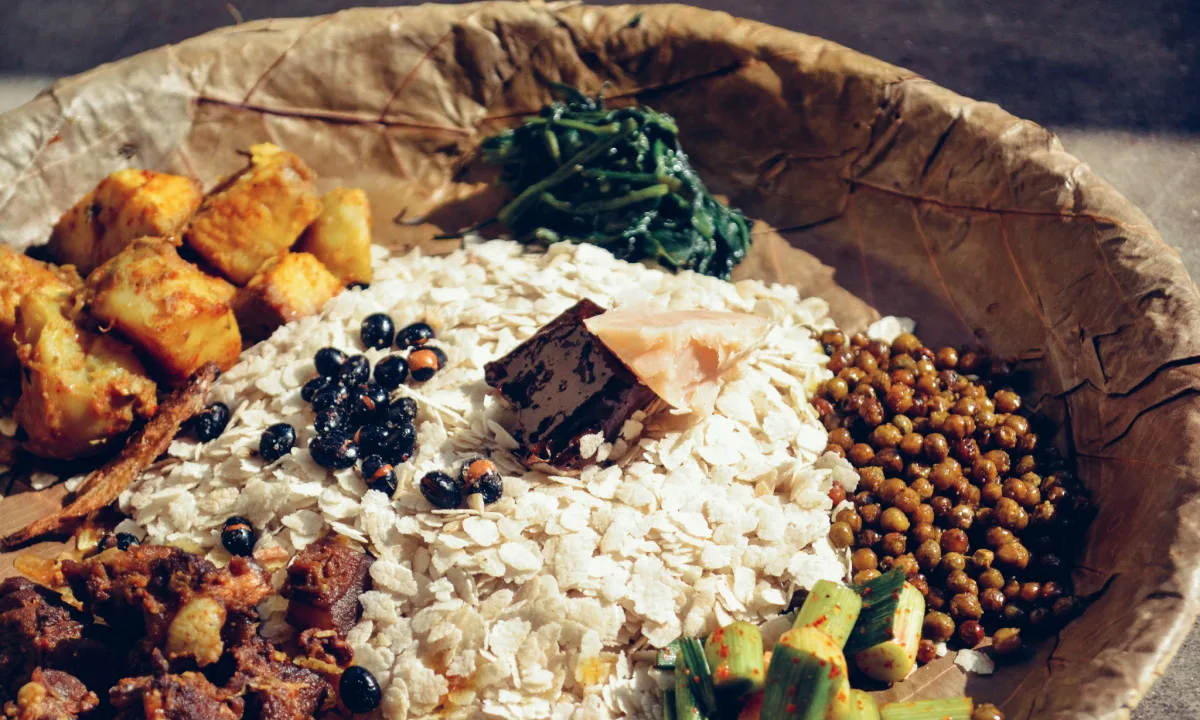
Samay baji is the Newari community's signature ceremonial meal: a large platter combining beaten rice (chiura), choila, black soybeans, boiled egg, ginger, and achar. The restaurant owner explained that traditionally, samay baji is offered to the gods first, only after that offering is it considered fit to eat. It's less a dish than a ritual with food attached, and it shows up at nearly every major Newari festival and family celebration.
2. Choila, Bara, and Chatamari
Three dishes anchor a Newari table:
- Choila: Spicy grilled meat, traditionally buffalo, marinated in ginger, garlic, chili, and cumin, then grilled over straw.
- Bara: Savory lentil pancakes, crisp outside and soft inside, often topped with egg or minced meat.
- Chatamari: A rice-flour crepe often called "Nepali pizza," topped with minced meat, egg, or vegetables.
None of these are interchangeable with their Indian namesakes; the rice-flour base and the specific spice marinades are distinctly Newari.
3. Juju Dhau: The King of Yogurt
Bhaktapur has one culinary claim that's genuinely singular: juju dhau, or "king of yogurt." Made from buffalo milk and set in clay pots for slow fermentation, it develops a thick, custard-like texture and a caramelized top layer unlike any yogurt you've likely had. It's sold in small clay bowls throughout the city and is, without much competition, the best yogurt I've ever eaten.
4. Yomari
A steamed rice-flour dumpling traditionally shaped like a pointed pouch and filled with chaku and sesame seeds or dried milk solids. Yomari is especially associated with Yomari Punhi, a Newari festival in which families prepare and share the dumplings. Warm, chewy, and sweet, it offers a welcome contrast to the spicier dishes on a Newari spread.
The Parts Nobody Warns You About Newari Cuisine
Newari cuisine doesn't waste any part of the animal. On a fuller ceremonial menu you may find liver (senla mu), lungs (swanpuka), intestines (bhuttan), tongue (mainh), brain (nhyapu), and steamed blood (chohi). I'll be honest: I tried exactly one of these and didn't finish it. That's not a criticism of the food, it's a genuinely different relationship with the whole animal than most Western diners are used to, and it deserves respect rather than a checklist tick.
The Culture of Dal Bhat
1. Being Told to Eat With Your Hand
At a homestay outside Pokhara, my host set down a metal plate, rice at the center, dal at side bowl, small bowls of curry, greens, and achar around the rim, and gestured for me to eat with my right hand, not a fork. Getting food onto your palm is considered a sign of clumsiness, and I proved that rule correct almost immediately. The left hand stays out of it entirely; it's reserved for other tasks and considered unclean at the table.
2. What "Dal Bhat Power, 24 Hour" Actually Means
I finally asked. My host laughed and said it simply: dal bhat is what gets a farmer through a full day of fieldwork, what gets a porter through a full day on the trail, and what gets a family through a full day of anything. It's not a slogan invented for tourists — it's a genuine description of the dish's role as an all-day fuel source, which is exactly why it's plastered on T-shirts sold to trekkers throughout the Annapurna region.
3. The Bowl That Kept Refilling
Dal bhat is traditionally served as an unlimited meal. Halfway through, my host appeared with more rice, then more dal, then asked again and kept asking until I physically waved her off. This isn't hospitality theater; it's how the meal is meant to work. If you're trekking the Annapurna Circuit or heading toward Everest Base Camp, this refill custom is precisely why dal bhat remains the most practical trekking food in Nepal. It's filling, balanced, and essentially bottomless.
Foods of the Hills: Gundruk and Dhido
Two dishes define hill and mountain cooking in Nepal:
- Dhindo: A thick porridge made from buckwheat, millet, or corn flour mixed into boiling water. Once dismissed as poor people's food because it lacked rice, dhindo has become genuinely popular for its nutrition and texture. It’s generally eaten by tearing off small pieces with your hand and dipping them into curry.
- Gundruk: Mustard greens, radish leaves, or cauliflower leaves that are sun-dried, packed into earthenware pots, and left to ferment for days before drying again in the sun. The fermentation process is similar to what produces kimchi, and the result is sharp, sour, and deeply savory.
Achar — The Flavor on Every Table
No Nepali dish arrives undressed. Achar is the umbrella term for Nepal's pickles, chutneys, and dipping sauces, tomato-based, sesame-based, or built from pickled radish, potato, or hemp seed. A single teaspoon can carry more heat and depth than the entire dish it's served with, and locals treat it as essential, not optional.
4. Thukpa, Tea, and Shared Warmth
Climb high enough on any Himalayan trekking route, and rice becomes scarce, farmland disappears, and the kitchen adapts to cold, altitude, and limited supply.
1. The Hot Bowl of Thukpa
At a stone-walled teahouse somewhere past 3,000 meters, a bowl of thukpa, a Tibetan-origin noodle soup with thick wheat noodles, vegetables, and a warm broth, did more for morale than any piece of gear in my pack. Thukpa made its way into Nepal alongside Tibetan migration and is now a staple on nearly every trekking-route menu, usually spicier here than the original Tibetan version.
What is thukpa? Thukpa is a hearty Himalayan noodle soup made with thick wheat noodles, broth, vegetables, and often meat, traditionally eaten in high-altitude regions of Nepal and Tibet for warmth and sustained energy.
2. Tibetan Bread, Yak Cheese, and Butter Tea
Sherpa and Gurung communities along major trekking routes serve a distinct menu built around what actually grows or survives at altitude:
| Dish | What It Is | Where You'll Find It |
|---|---|---|
| Tibetan/Gurung bread | Fried flatbread, often eaten with honey or eggs | Everest and Annapurna teahouses |
| Yak cheese (churpi) | Hard, tangy cheese made from yak milk | Langtang Valley |
| Butter tea | Salty tea made with yak butter | High-altitude Sherpa regions |
Butter tea, unlike the sweet milk tea served everywhere else in Nepal, is genuinely an acquired taste, salty rather than sweet, but it's exactly what your body wants after hours in the cold.
3. Chhaang and Tongba
In the evening, a porter passed around a wooden vessel of tongba; fermented millet, topped up repeatedly with hot water and sipped through a bamboo straw. Chhaang, a related fermented drink made from barley, millet, or rice, is served similarly. Neither is particularly strong, but both come with something more valuable at altitude: they're communal. Everyone at the table drinks from the same pot, tops it up for the next person, and the conversation moves accordingly.
What I Carried Back Home
One Last Sel Roti at Early Morning
On the day of my flight back home, I strolled around a nearby teashop in Thamel and had tea with sel roti, a ring-shaped, deep-fried bread made from a sweetened rice-flour batter, traditionally prepared during the festivals of Dashain and Tihar. Chewier and less sweet than a Western donut, it's sold year-round now, and it was the same steam-and-street-stall energy that had greeted me on day one.
What Nepal Actually Taught Me About Eating
Nepali food isn't built to impress you in a single bite. It's built to sustain you, through a workday, a trek, a festival, a family gathering. The phrase that followed me the whole trip, "dal bhat power, 24 hour," turned out to be the entire philosophy of Nepali cuisine compressed into four words: food as fuel, hospitality, and identity, all served on one plate.
Nepali Dishes at a Glance
Street Food and Snacks
- Momo — steamed or fried dumplings (veg, chicken, or buffalo)
- Samosa / Samosa Chaat — fried potato pastry, often served with yogurt and chutney
- Chatamari — Newari rice-flour crepe, "Nepali pizza"
- Pani puri — crisp shells filled with spiced water and potato (check current safety status before eating)
- Sukuti — spiced, dried buffalo, goat, or yak meat
Staples and Breads
- Dal bhat — lentil soup and steamed rice; Nepal's national dish
- Dhindo — buckwheat, millet, or corn porridge
- Gundruk — fermented leafy greens
- Kodo ko roti — millet flatbread
- Dal puri — fried lentil-stuffed flatbread, common in the Terai
- Tibetan/Gurung bread — fried flatbread found on high-altitude trekking routes
Newari Specialties
- Choila — spicy grilled buffalo, goat, or chicken
- Bara — savory lentil pancakes
- Samay baji — ceremonial Newari platter
- Juju dhau — Bhaktapur's signature buffalo-milk yogurt
- Yomari — sweet steamed rice-flour dumplings filled with molasses
- Kwati — nine-bean soup eaten during Janai Purnima
Festival and Sweet Dishes
- Sel roti — sweet fried rice-flour bread, made for Dashain and Tihar
- Kheer — cardamom-and-saffron rice pudding
- Kasaar — sweet rice-and-ghee wedding balls
- Khajuri — deep-fried festival cookies
Drinks
- Chhaang — mildly fermented barley, millet, or rice drink
- Tongba — fermented millet drink, sipped through a bamboo straw
- Raksi — distilled rice or millet liquor
- Butter tea — salty tea made with yak butter, common at altitude
Why Nepali Food Deserves Its Own Story
Nepali food is not a regional variation of Indian cuisine, it's a distinct culinary tradition shaped by the Himalaya, centuries of trade, and Nepal's own ethnic diversity.
Modern Nepali cuisine is best understood as three influences overlapping on a single plate: Indian flavor (cumin, turmeric, chili, coriander), Tibetan technique (steaming, noodle soups, dumplings), and an indigenous Nepali food culture built around lentils, rice, fermented greens, and, depending on the ethnic group, very different rules about meat, dairy, and ceremony.
If you would like to experience Nepal beyond its food, Travories helps you compare and book verified treks, tours, trail runs, and other local adventures. From Kathmandu’s food streets to Himalayan teahouses, you can find experiences that let you taste Nepal and explore it at your own pace.
FAQs
What is the national dish of Nepal?
Dal bhat is the national dish of Nepal. It consists of lentil soup (dal) poured over steamed rice (bhat), served with vegetable curry, pickles, and greens. Most Nepali people eat it once or twice a day, and it's traditionally served as an all-you-can-eat meal.
What are traditional Nepalese foods?
Traditional Nepali foods include dal bhat, dhindo, gundruk, sel roti, yomari, bara, chatamari, aloo dishes, and various pickles and achars. Newari cuisine, in particular, is known for its wide variety of traditional dishes and snacks.
What food is famous in Nepal?
Momo and dal bhat are among the foods Nepal is best known for. Momo are steamed or fried dumplings filled with vegetables or meat and served with a spicy dipping sauce. Dal bhat is Nepal's everyday staple and is widely eaten across the country.
Is Nepali food spicy?
Nepali food ranges from mild to quite spicy depending on region and dish. Newari cuisine from the Kathmandu Valley tends to be the spiciest, while dal bhat in rural homes is often milder and adjusted to taste with achar (chili-based condiments) added separately.
What's the difference between Nepali and Indian food?
Nepali food shares spices and some dishes with Indian cuisine but is shaped by distinct Tibetan and indigenous Himalayan influences, including dumplings (momo), noodle soups (thukpa), fermented greens (gundruk), and buckwheat staples (dhindo) that aren't part of mainstream Indian cooking.
What should vegetarians eat in Nepal?
Vegetarians can eat well in Nepal thanks to dal bhat, which is commonly vegetarian by default, along with vegetable momos, gundruk, dhindo, aloo (potato) curries, and most Newari side dishes aside from meat items like choila and sukuti.
Is street food in Nepal safe to eat?
Street food in Nepal can be safe and enjoyable, but hygiene varies between vendors. Choose busy stalls with high customer turnover, freshly cooked food served hot, and vendors who handle food hygienically. Be more cautious with raw salads, uncovered foods, and ice or water of uncertain origin, particularly if you are not accustomed to local conditions.
What do people eat while trekking in the Himalayas?
Trekkers in the Himalayas primarily eat dal bhat, thukpa, Tibetan bread, and instant noodle-based dishes served at teahouses along routes like the Annapurna Circuit and Everest Base Camp trek. Dal bhat is favored for its filling, balanced, refillable nature.
Sarans Pandey
www.facebook.com/saranspandey89Travel enthusiast and Travel writer
Comments
Join the conversation and share your thoughts.
Loading comments…