What Nobody Tells You About Climbing Everest
A Nepali climber summited on May 20, 2026. What he told us afterwards had almost nothing to do with the summit


What Nobody Tells You About Climbing Everest
Most Everest stories are told by Westerners. Someone who flew in from London or New York, ticked the world's highest peak off a bucket list, and came home with a sponsor and a memoir.
Sudhigya Pant's story is different.
He's Nepali. He grew up with the Himalayas outside his window. The mountain isn't a bucket list item for him — it's a neighbour he spent over a year preparing to visit properly. Nine months of training, then three more. He knew the Sherpas climbing beside him, knew their families, knew their summit counts by heart.
And when he stood at 8,849 metres on May 20 at 11:25 AM, what he saw — and what he told us when we sat down with him weeks later — was nothing like the Everest stories you've already read.
“I do not have any words for that view,” he said. “Literally no words.”
He wasn't talking about the summit.
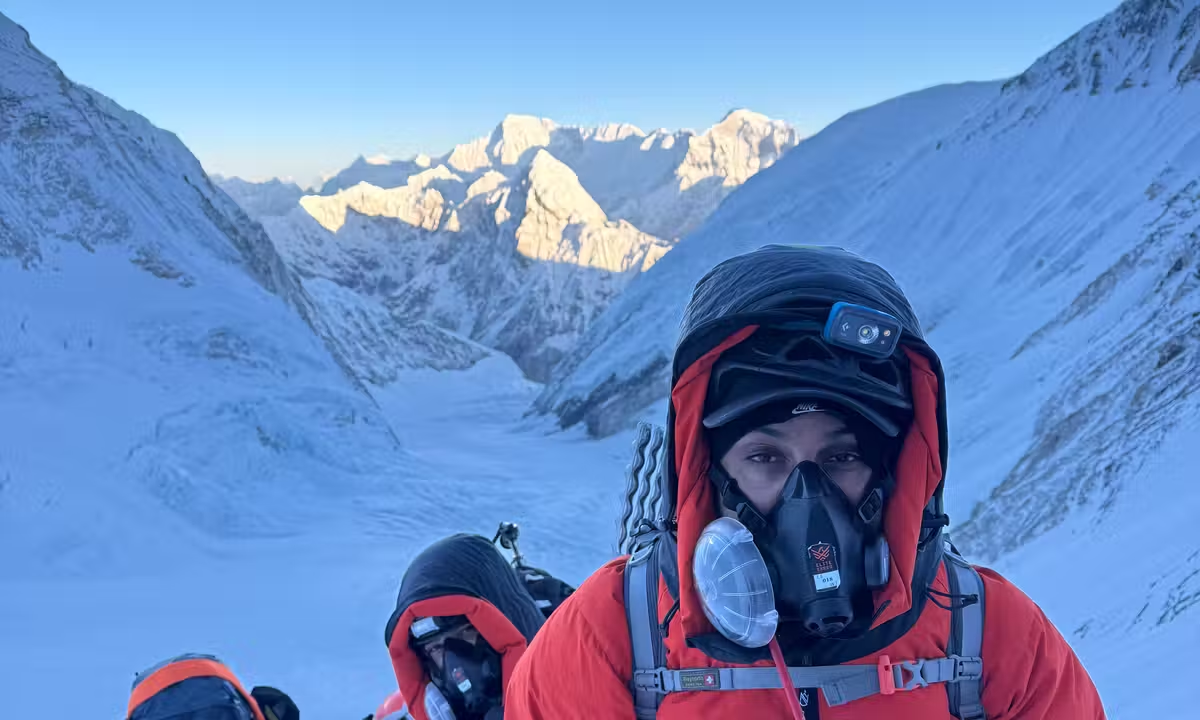
He Trained for a Year. The Last Three Months, He Did No Weights.
A year. That's what Sudhigya gave to a single morning on a mountain.
Nine months of continuous weight training, then a complete switch to pure cardio for the final three months. The reason was specific: muscle mass at altitude demands more oxygen. Arrive at 8,000 metres with too much of it, and your body becomes its own enemy—every training decision for twelve months filtered through that one calculation.
He wasn't a beginner walking in blind. He'd already climbed three peaks above 6,000 metres — Chulu in the Manang region of northern Nepal, Mera Peak, and Lobuche East, all serious climbs that most international trekkers spend years working towards. But after the third, a question kept getting louder: was staying a 6,000-metre climber enough? Or should he push extra?
We asked the question that makes people uncomfortable. Was it about ego?
He didn't flinch. “I think it might be ego,” he said. “The ego of—shall I be a 6,000er climber, or should I push extra? That thing was always in my mind.”
There was a second thread running alongside the personal one: launching his brand, Kapi, at the summit. Something concrete at the top of the world. But he was clear-eyed that the ego question and the achievement question were both in the room at the same time, and he wasn't going to pretend otherwise.
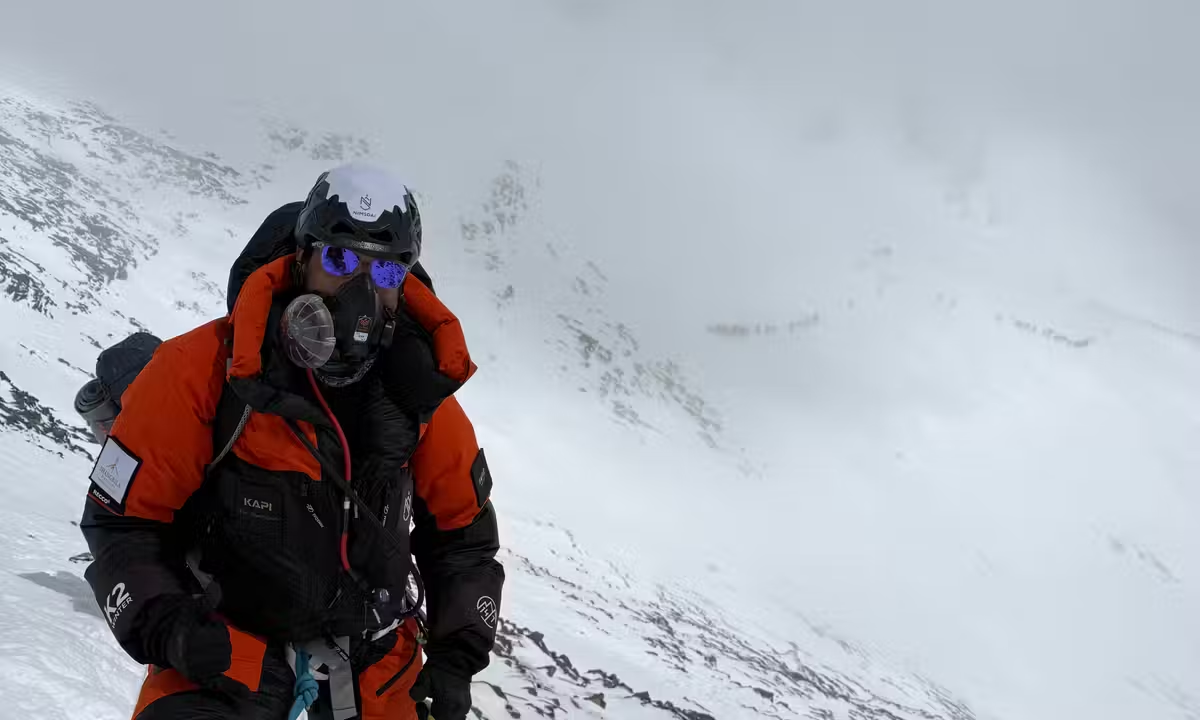
One More Step. That Was the Whole Plan.
At Camp 4 — the last rest stop before the summit, at around 7,950 metres — while the rest of the team was resting, Sudhigya was walking around.
He says this not to flex but to note that the preparation was held. His endurance coped. It was still brutally hard — he's explicit about that — but the gap between what the mountain demanded and what his body could give was smaller than it might have been.
The harder battle, it turned out, was entirely inside his head. Specifically: keeping his family out of it.
“While pushing, sometimes a family picture tried to come — father, mother, my wife and children. But as soon as those memories tried to break into my mind, I kicked those things out.”
It sounds harsh when you put it like that. His reasoning was simple: those images pull at something specific and deep, something that has nothing to do with the next step. Once they get in, the distraction compounds. You're not just slowing down. You're reorienting everything.
There was something else that helped too — something he mentioned almost as a footnote, laughing when he said it. They laughed. A lot. At the worst moments, through the hardest sections. Their Sherpa dai kept telling them to stop, that laughing here would break everyone's focus. They couldn't help it. Sudhigya thinks the laughter got them to the top.
His core mental system was smaller than you'd expect. One more step. Just one more step. That was all of it — applied rung by rung, breath by breath, all the way to 8,849 metres.
" As soon as those memories tried to break into my mind, I kicked those things out. One more step. Just one more step. That was my motto — and right now that motto worked and I am grateful to the universe."
The Moment in the Khumbu Icefall When He Thought It Was Over
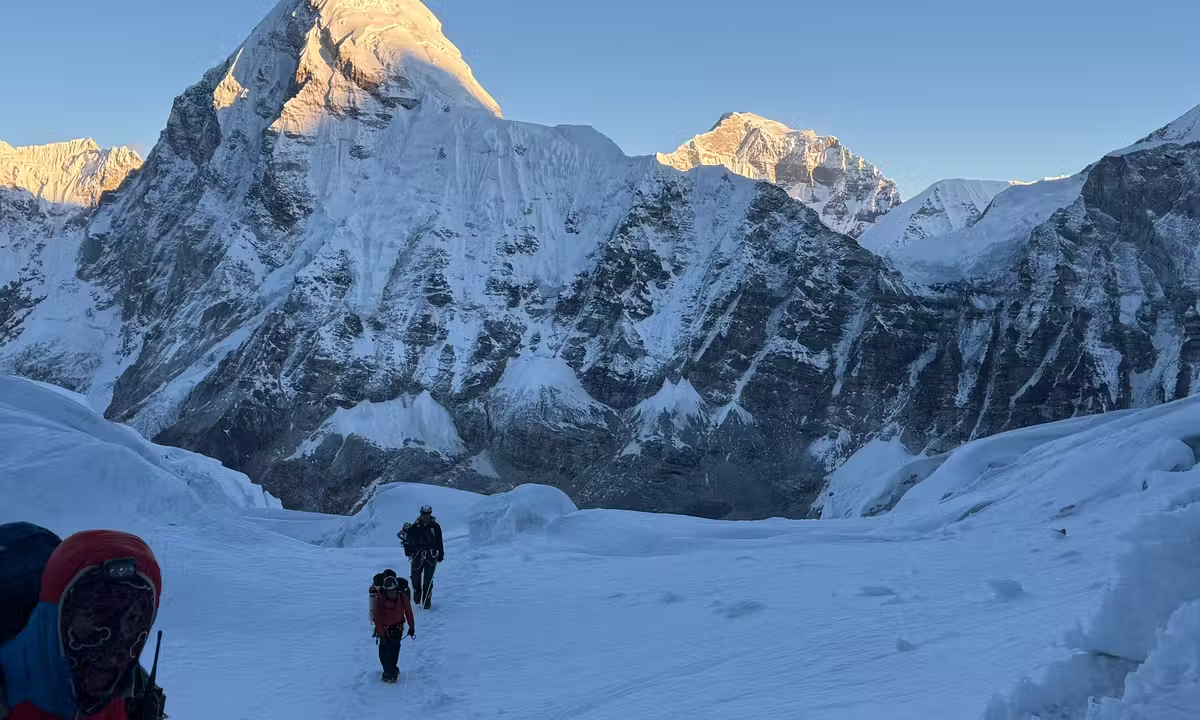
To reach the Everest summit from the Nepal side, every climber must pass through the Khumbu Icefall — a churning, shifting mass of glacial ice that sits just above Base Camp. It is widely considered one of the most dangerous stretches on any mountain anywhere in the world. The ice moves. Constantly.
Inside the icefall, there's a section where climbers cross horizontal ladders lashed together over open crevasses. You've probably seen photos of it: people in full high-altitude gear, inching across rungs suspended above nothing. The photos make it look dramatic. Being in the middle of one of those ladders makes 'dramatic' feel like entirely the wrong word.
Sudhigya was descending through this section when a rockfall started near a peak inside the icefall called Lola. He couldn't look anywhere. Not down into the crevasse. Not toward the sound. Just the ladder. Just the next rung.
“At that point, I thought this was the end,” he said.
It wasn't. The rocks fell far enough away. But the sound — he pauses every time he gets to this part of the story.
Earlier, on a rotation phase, a different kind of close call had happened. Their guide was Yukta Gurung — a climber from Nepal's Gurung community and the first person from that community to summit Everest ten times. During a water break inside the icefall, Yukta stopped them cold: 'You won't die right now without water here, but stopping in this spot will get you killed.' They kept moving.
Twenty minutes later, at the exact place where they'd been standing, two Sherpas fell into a crevasse when the ice shifted.
Sudhigya said sitting beside Yukta Gurung on the mountain and listening to his stories is the kind of thing that keeps showing up in his mind long after he is back home.
" He told us: you won't die right now without water here, but if you stop then you will definitely die. Twenty minutes later — at the exact spot — two Sherpas fell."
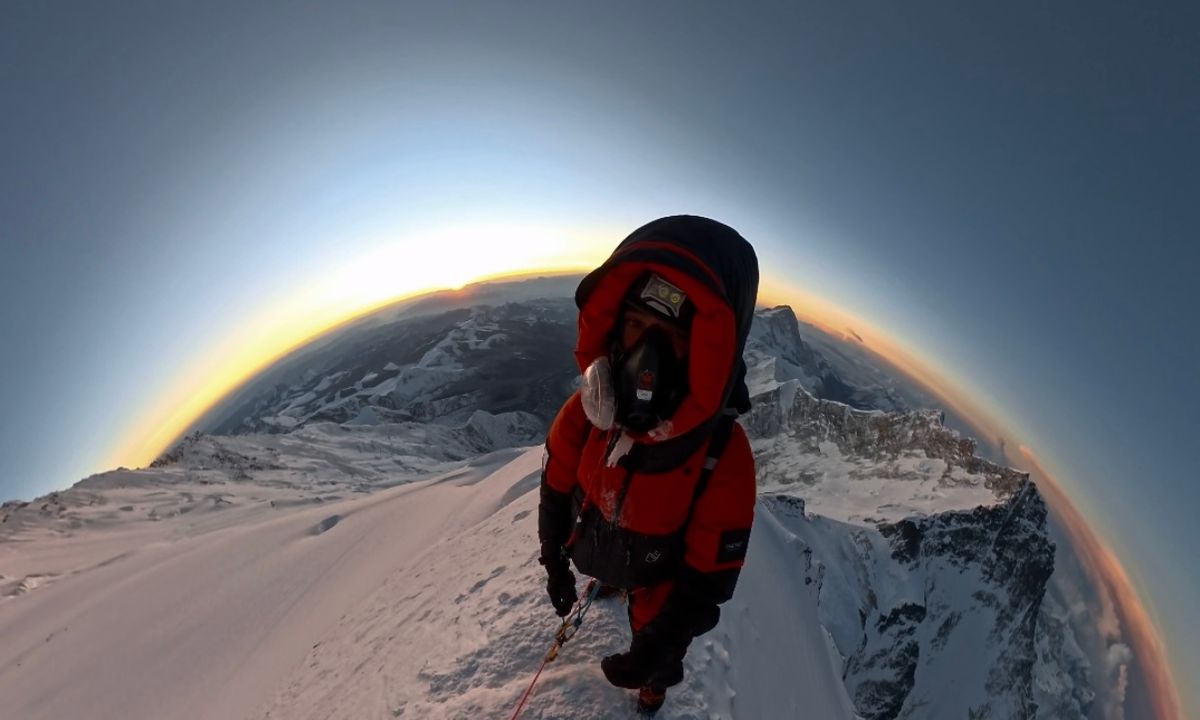
Not the Summit. The Balcony.
Here is what you picture when you think about Everest: the summit. Flags. The iconic photograph with the oxygen mask and the prayer flags. Wind, maybe.
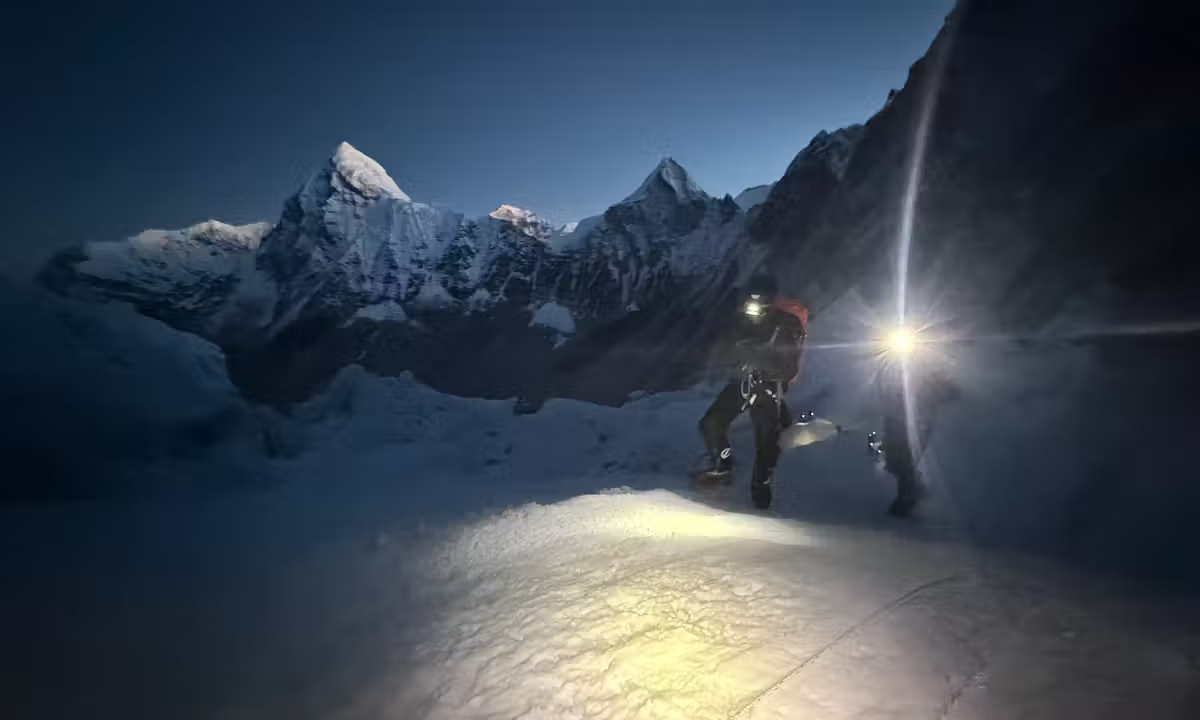
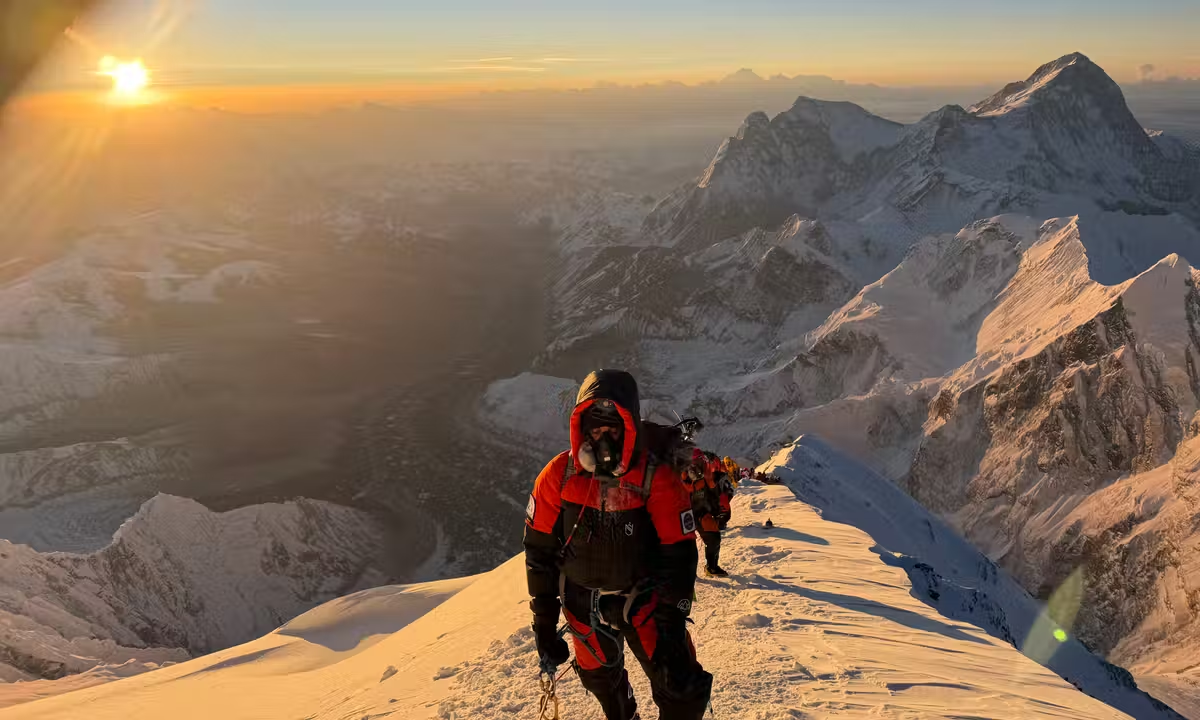
You're not picturing the balcony. On the Southeast Ridge route — the standard Nepal side approach — there is a natural plateau at around 8,400 metres known as the Balcony. It sits roughly 400 vertical metres below the summit. Most accounts treat it as a waypoint, a place to catch your breath before the final push. Sudhigya Pant arrived there just as the sky was beginning to change from black to something else entirely.
And then something happened that he has tried to describe to multiple people, in multiple conversations, and given up on every single time. He could see the curvature of the Earth. Not as an abstract fact he knew to be scientifically true, but as a visible, undeniable thing in front of his eyes. The horizon bent. And the stars, which by any reasonable orientation of the world should have been above him, were below.
Not metaphorically. Physically below his feet.
“I do not have any words for that view,” he says. He says it twice in the same conversation and means it literally both times. It's not false modesty. It's the specific frustration of trying to bring back something that exists entirely outside the range of any language you already have.
Everyone asks him about the summit. How did it feel? What did you see? He understands why they ask. But the real answer – the one that pulls at him from back home in Kathmandu – is the balcony at 8,400 metres, in the dark, before the sun came up, with the planet visibly curving away beneath you and the stars sitting below like scattered lights on a city you've flown over.
“Now imagine how good the view was,” he says, laughing. “And I am saying this about the balcony section. Not the summit.”
He told us: if someone handed him a blank page and said write the one thing about this climb that will never make it into any interview — he'd write about the Balcony. Non-stop. For the rest of his life. He's not entirely sure that's an exaggeration.
"You start to see the curvature of the earth. The stars look like they are below you. I do not have any words for that view. Literally no words."
Forty Minutes at the Top of the World
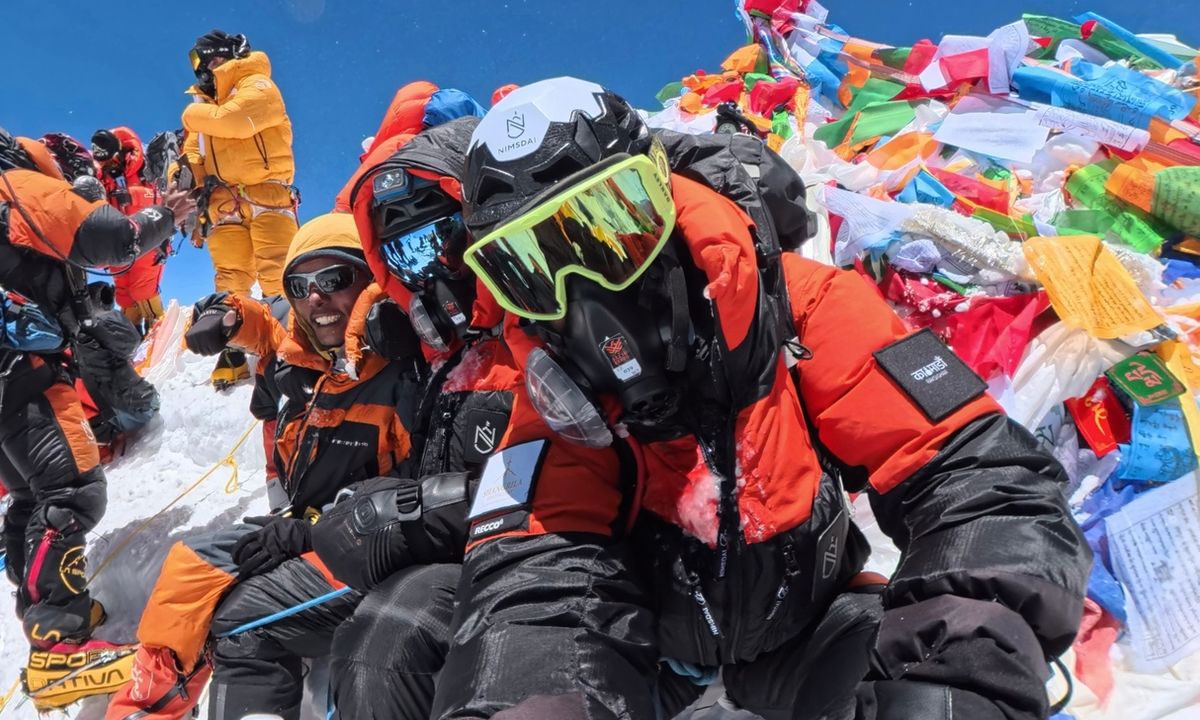
May 20. 2026. 11:25 AM. The summit. He stayed for about forty minutes.
They photographed. Changed oxygen cylinders. And Sudhigya launched Kapi – his brand – right there at 8,849 metres, which is either completely practical or completely absurd depending on how you look at it and is probably both.
Getting there took more than the climb. His lead sherpa was Gyalzen Sherpa, a guide with four Everest summits across both the Nepal and Tibet sides of the mountain. When the wind shifted to something that felt wrong during the push, Gyalzen told him flatly that it was normal for this route. One calm, factual sentence was enough to keep moving.
The emotion Sudhigya had spent a year expecting didn't arrive when he touched the top. It arrived at around ten metres short of it.
“When you see the summit 10 metres before, then you get very emotional. At that point, you start to remember all the things — your family, your friends, everyone who is there in your life.”
At the actual top, something quieter happened. “You realise how fragile you are,” he said. “It makes you too grounded.”
The clouds started forming. They turned around and went back down.
The Descent Nobody Warns You About
Here’s the thing the documentaries always skip:
The descent is harder than the climb.
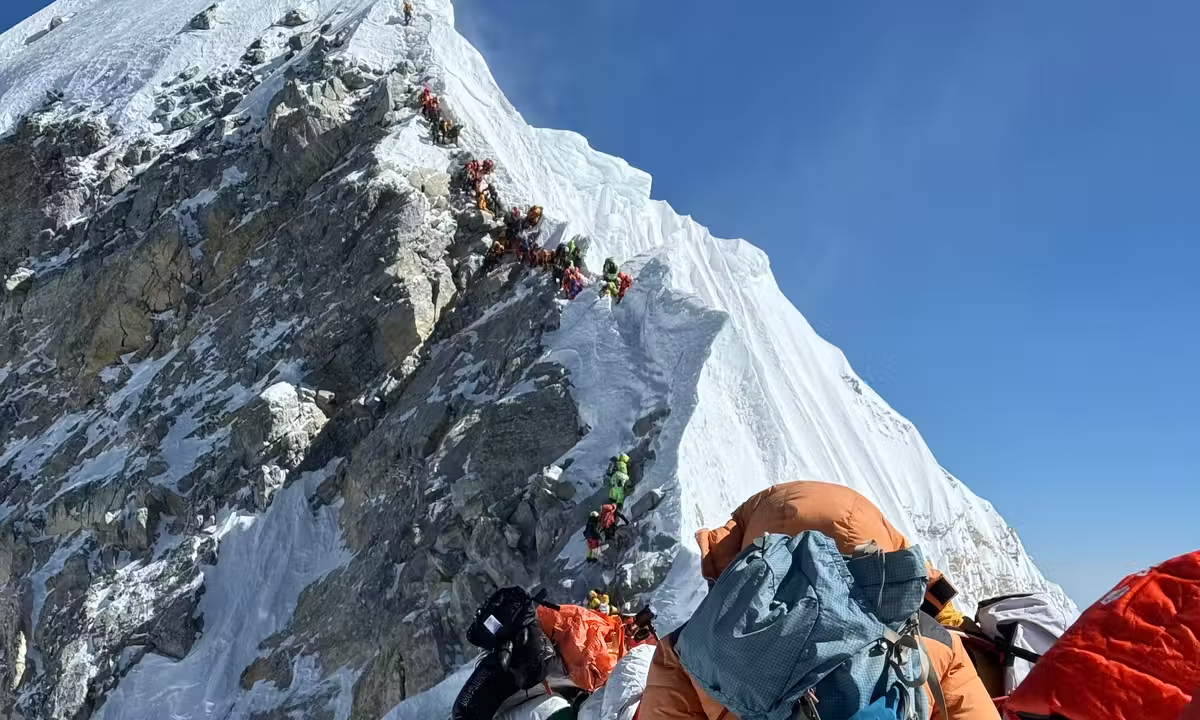
Sudhigya says this as a flat fact, not for effect. The summit to base camp is roughly 15 to 16 kilometres of vertical loss. Your legs have already spent everything going up. Going down is a completely different kind of punishment — slower in the worst possible way, dragging on long past the point where you think it should be over.
“Everyone says that the push is hard. But believe me, the descent is much more harder. You just go down and down, and it feels like ages.”
His advice for any international climber planning Everest: train specifically for the descent. Not as an afterthought, but with the same seriousness you give the push.
At his lowest energy point on the entire expedition — the moment where the gap between what he had left and what the mountain still demanded felt widest — the thing that actually worked was Coca-Cola. He laughs when he says it. Not a specialised altitude supplement. Not some ancient Himalayan secret. Fizzy, cold, improbable Coca-Cola. It gave him 15 to 20 minutes of real energy every time.
First meal after fully descending: noodles with egg at Camp 2. He describes it with the reverence people normally save for the best meal of their entire lives.
"Everyone tells that the push is harder, but believe me, the descent is much more harder. For fellow climbers planning Everest, be prepared for the descend."
The State of Everest That Nobody Is Photographing
Every year, thousands of international visitors come to Nepal to trek toward Everest or attempt its slopes. Many of them think of Everest as a pristine, untouched high-altitude wilderness. Sudhigya Pant wants to correct that assumption.
Camp 4 — the final camp before the summit push, sitting on the South Col at around 7,950 metres — is covered in trash. Decades of expeditions have left their mark, and the organised waste management that once operated up there has stopped. Sudhigya suspects a breakdown between the Nepal Army and the Sagarmatha Pollution Control Committee (SPCC). He doesn't know the full story. What he knows is that it's visibly bad, it didn't have to be this way, and someone needs to answer for it.
He also noticed foreign operators guiding clients without proper Nepali guide certification — purchasing mountain permits but bypassing the licensing system that protects both climbers and local guides. Illegal Starlink use at altitude. And rescue infrastructure that doesn't match the fees Nepal charges for permit costs.
“I think the Nepali government should do the rescue after charging so much in the name of the permit fee.”
For an international audience that cares about sustainable adventure tourism, this is the Everest conversation that needs more airtime.
Home Now. Still Thinking About Everest.
His stress is lower now. The anger — something he mentions without embarrassment — has quieted since the mountain. He can't fully explain it. Maybe the sheer scale of the thing resets something inside you; it's hard to stay wound up about ordinary friction when you've stood at the highest point on earth. Maybe it's the exhaustion still metabolising. Either way, something shifted.
When he was on Everest, all he thought about was getting home. Now that he's home, Everest is all he thinks about.
There's a feeling that mountaineers and trekkers returning from Nepal often describe — a pull back toward the mountains that doesn't go away when the trip ends. Sudhigya Pant, who grew up here and who climbed this range for years before attempting its highest point, is not immune to it.
“I guess this is what 'mountains are calling' means.” Half a joke. But only half.
Planning your own Himalayan adventure? Whether you're considering Everest Base Camp, a peak climb, or your first Nepal trek, Travories connects international travellers with verified, trusted local agencies across Nepal.
Traveller and Co-founder of Travories.
Comments
Join the conversation and share your thoughts.
Loading comments…